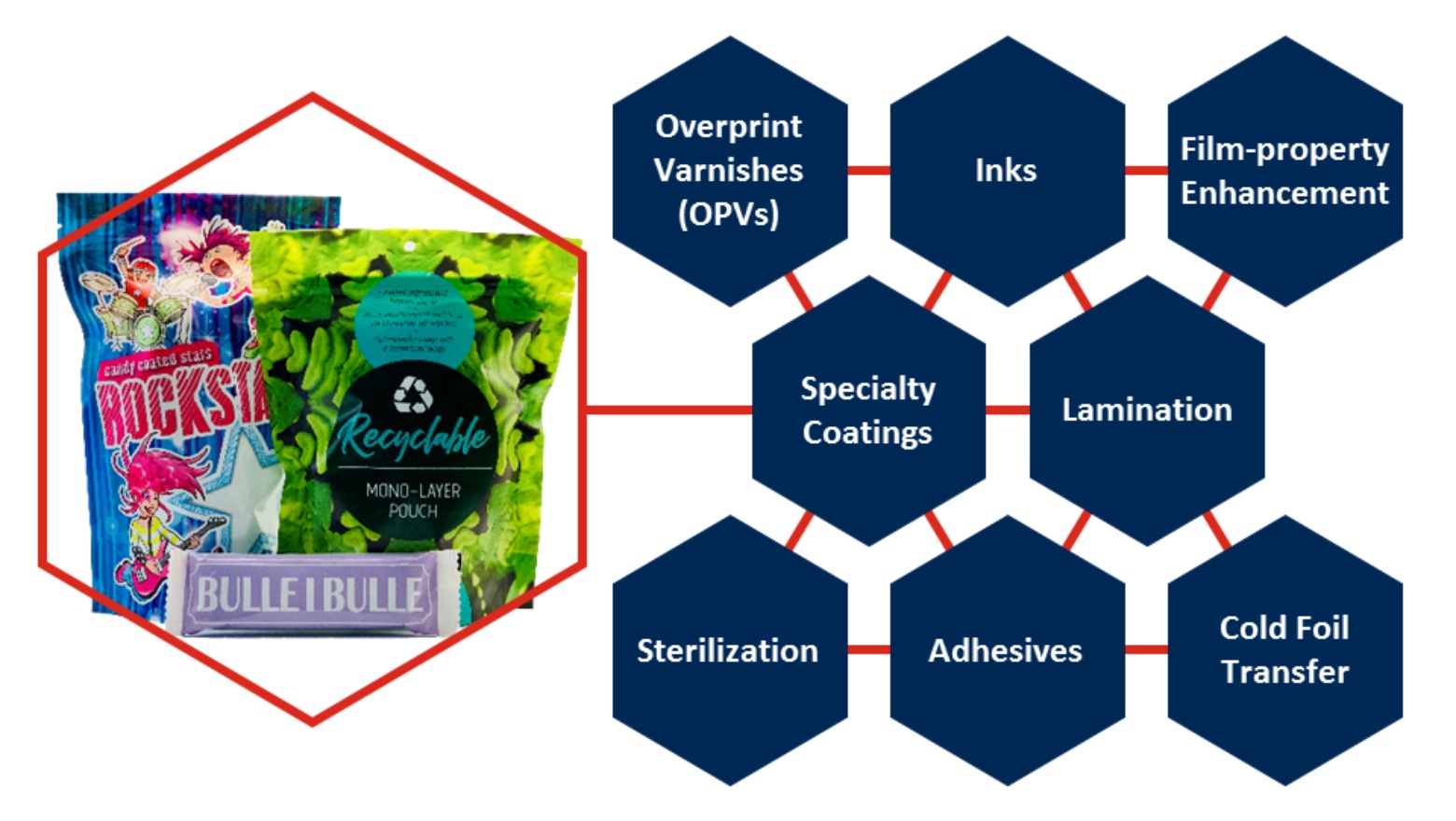
The core principle of electron beam technology is accelerated electrons break chemical bonds. What happens afterward (bonds remain broken, reform, and/or initiate a reaction) is chemistry. How this principle is used to create ebeam applications is up to your ingenuity!
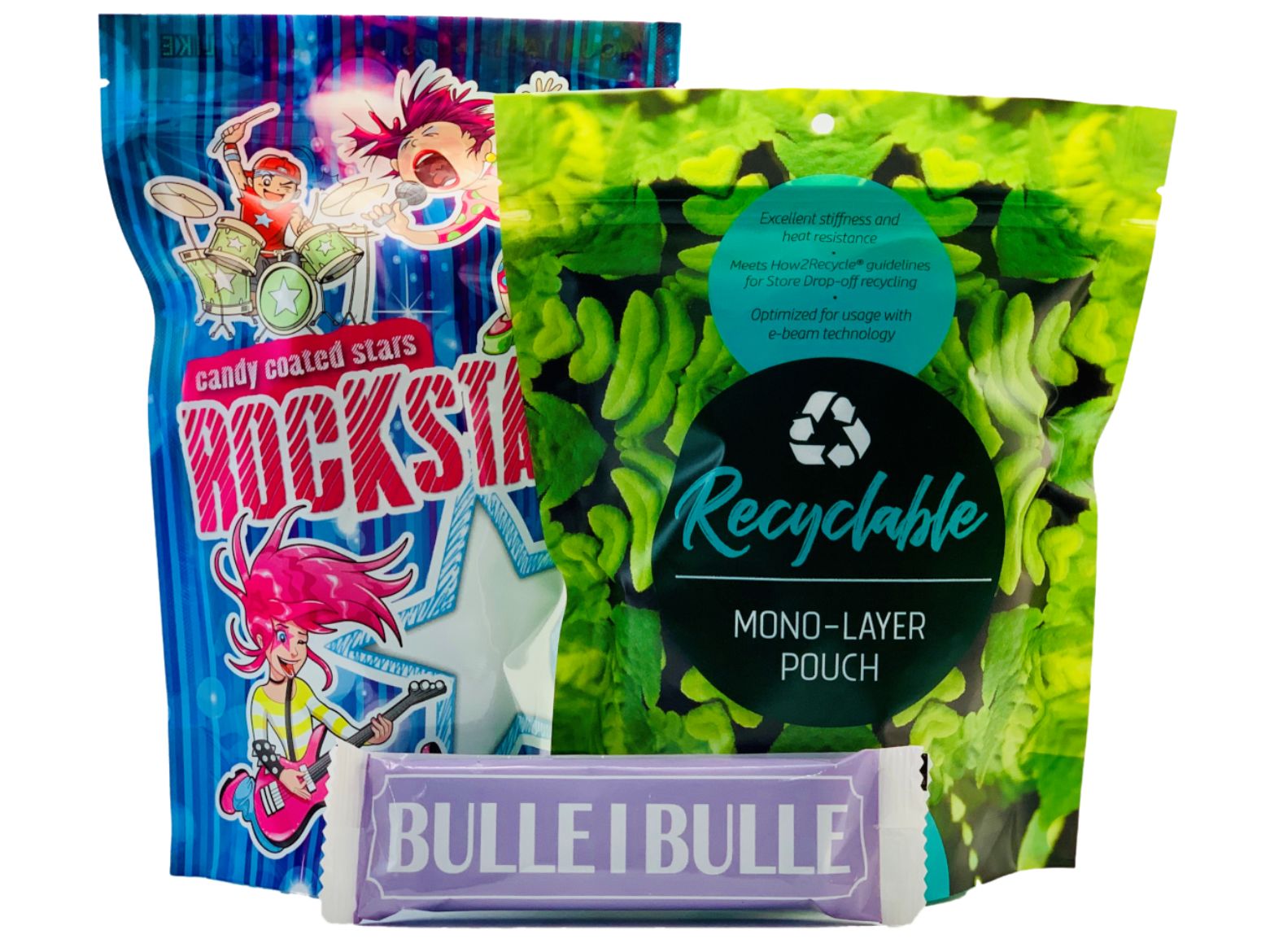
Flexible Packaging
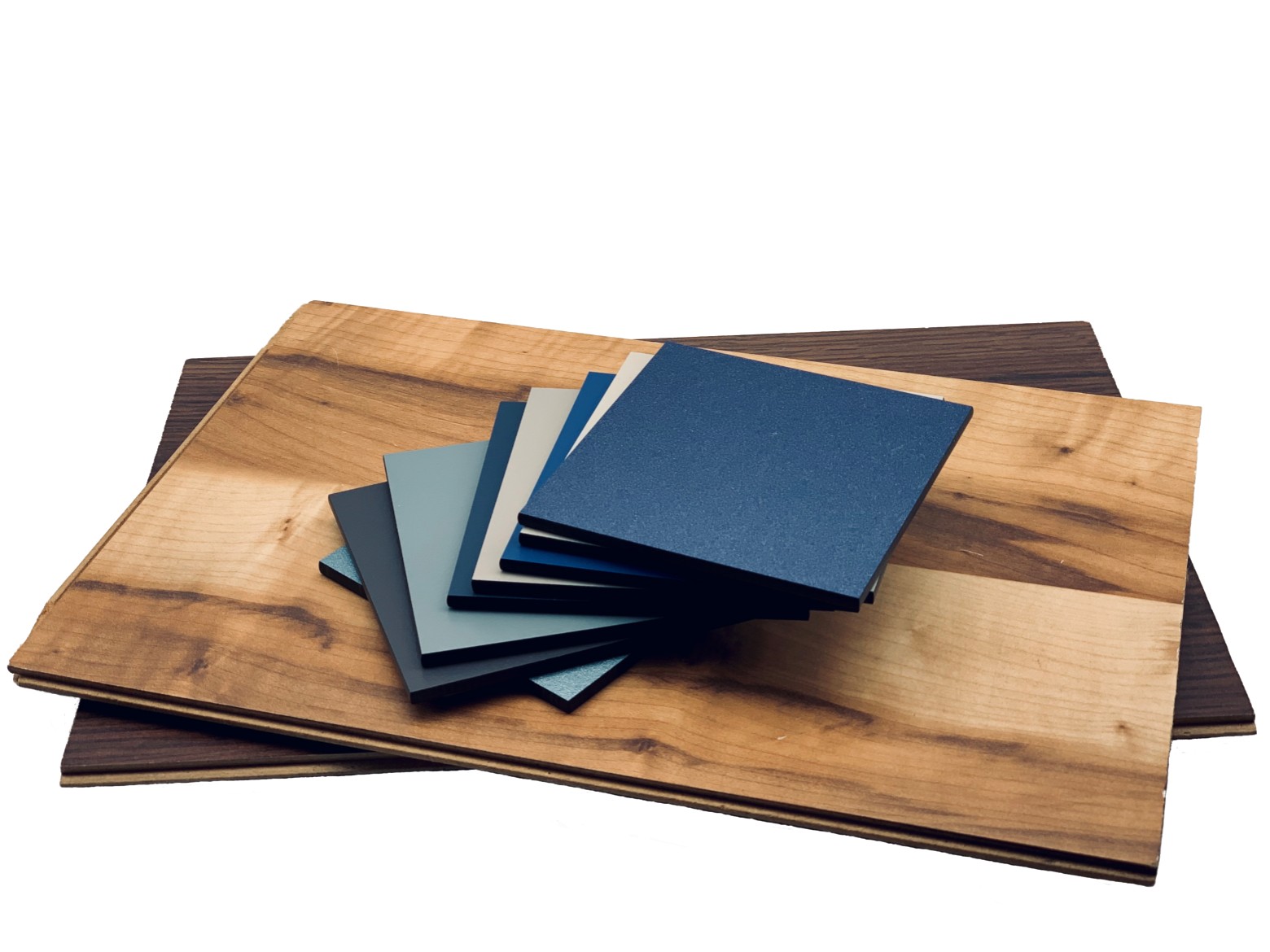
Interior/Exterior Architectural Products
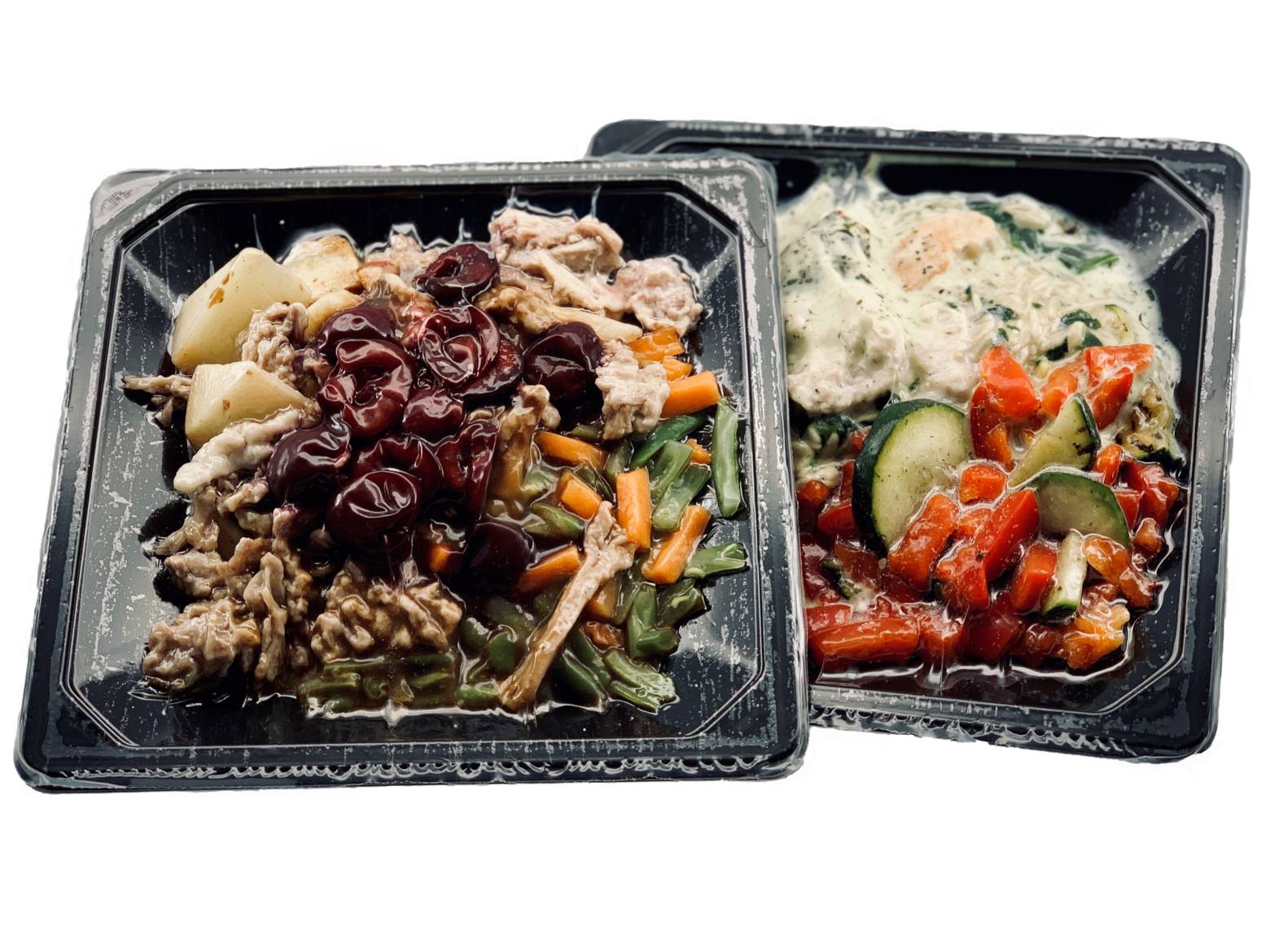
Vacuum Skin Packaging
Sterilization and Disinfestation
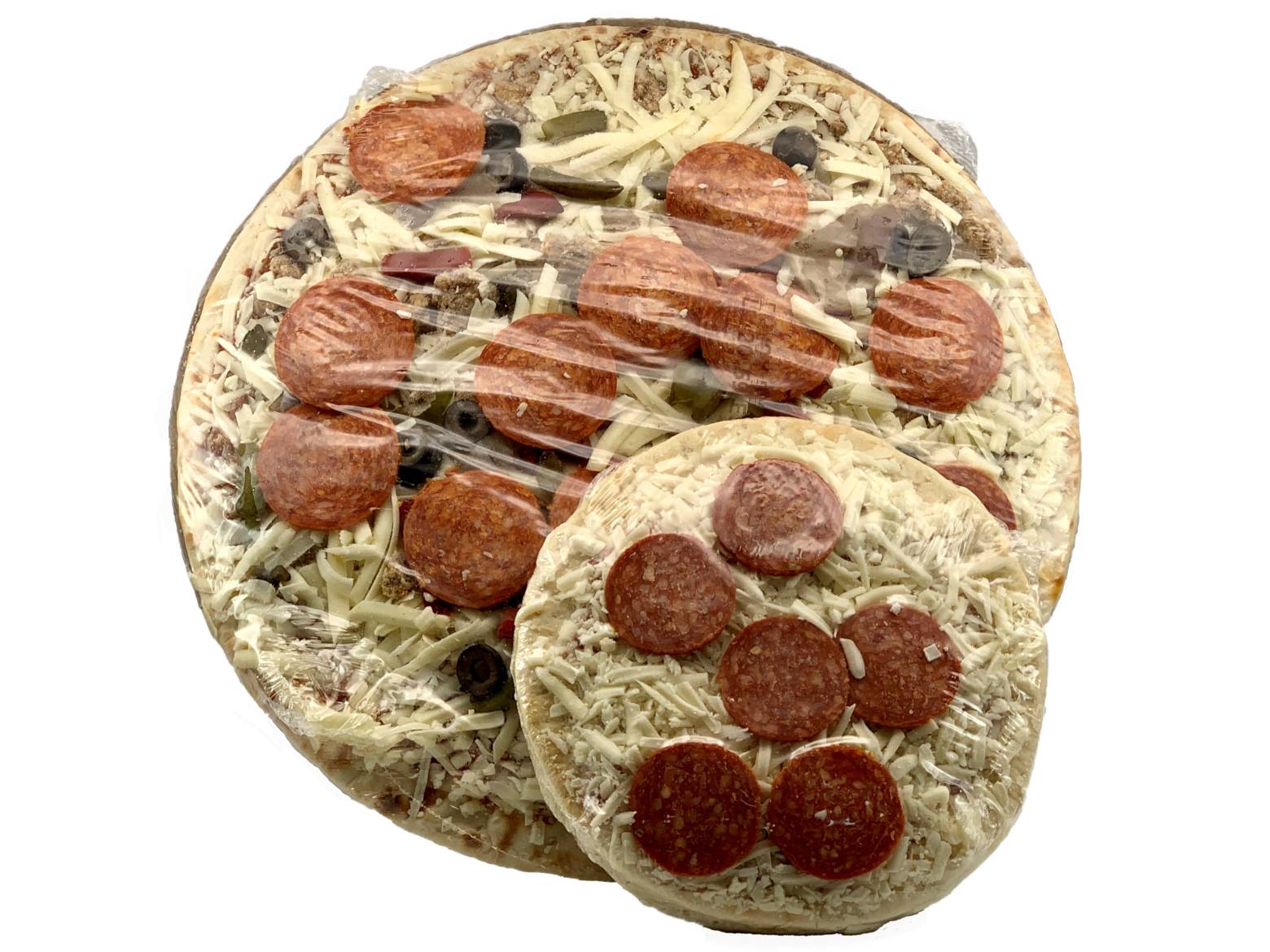
Heat Shrinkable Films and Sleeves
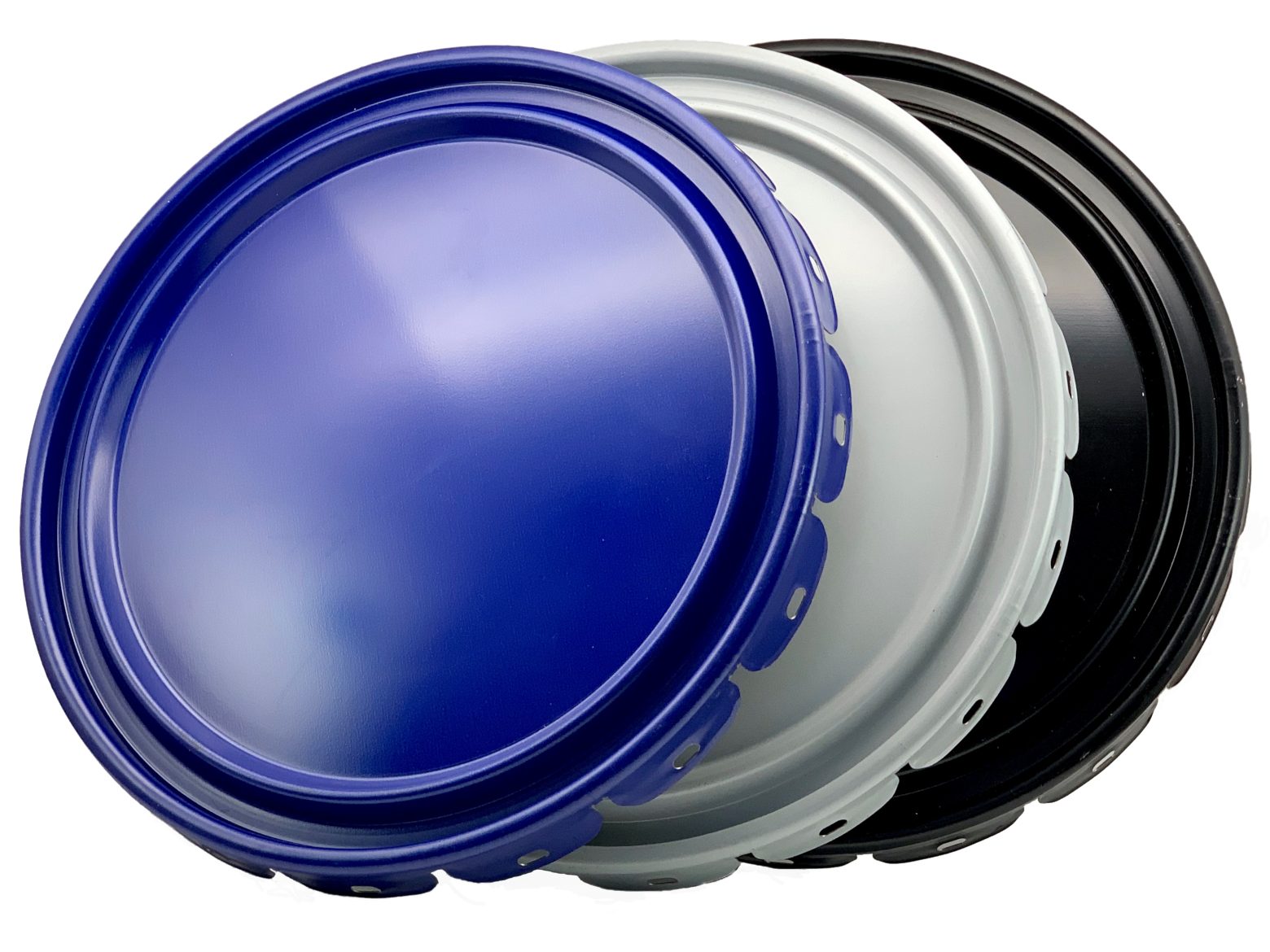
Coil Coating
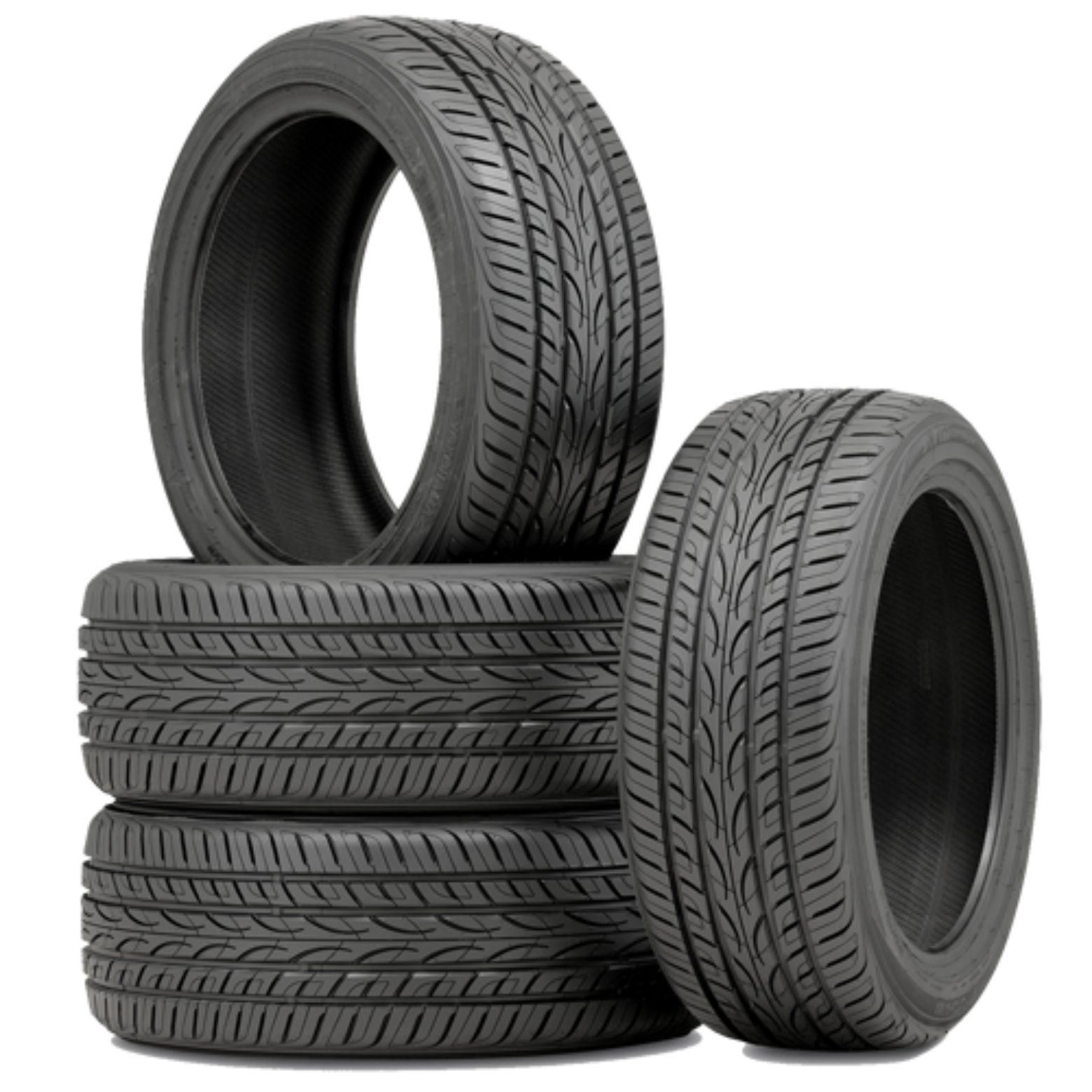
Tires
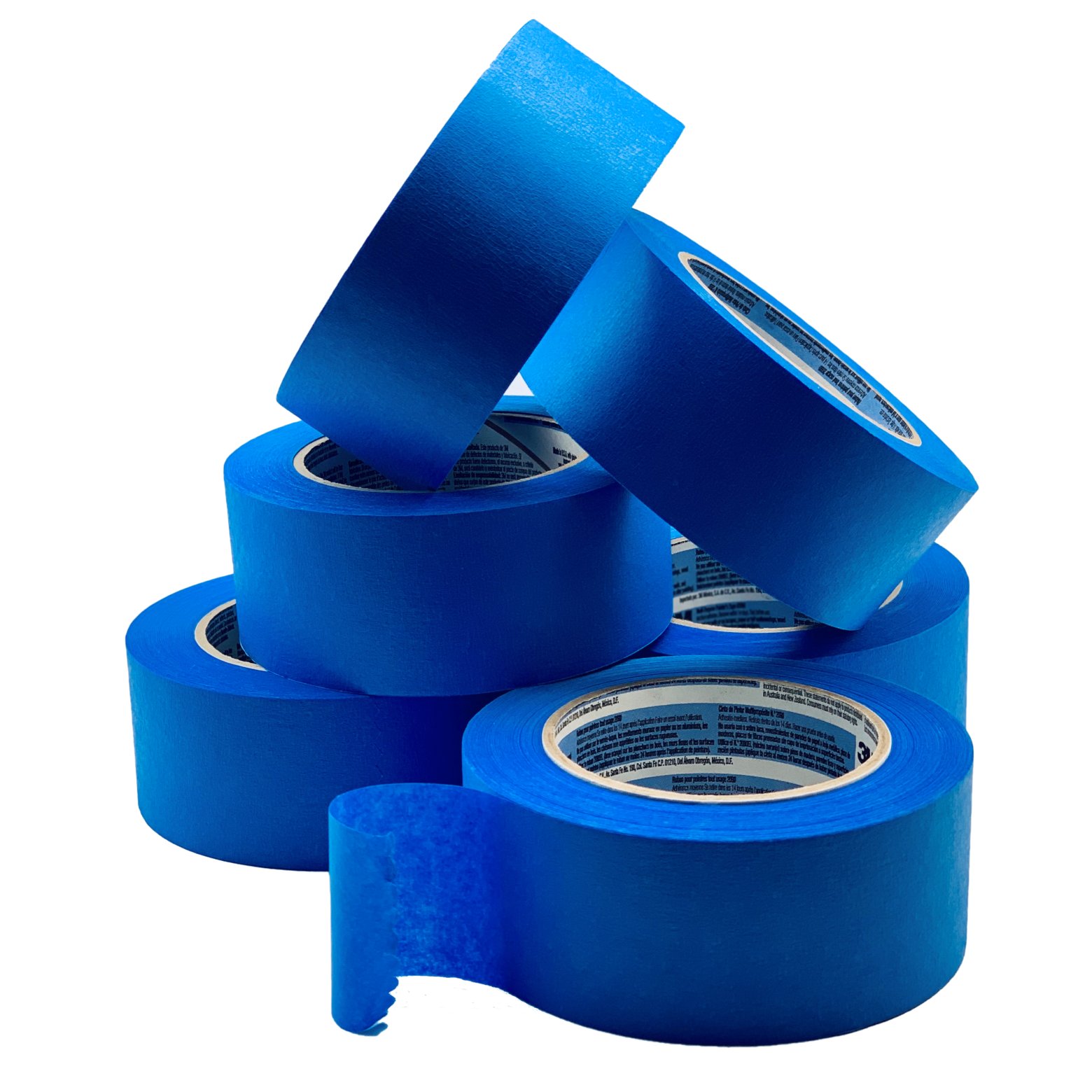
Pressure Sensitive Adhesives
Paperboard Packaging
…and much more!
Even within an individual application, ebeam can be used to achieve numerous effects.
How does ebeam work?
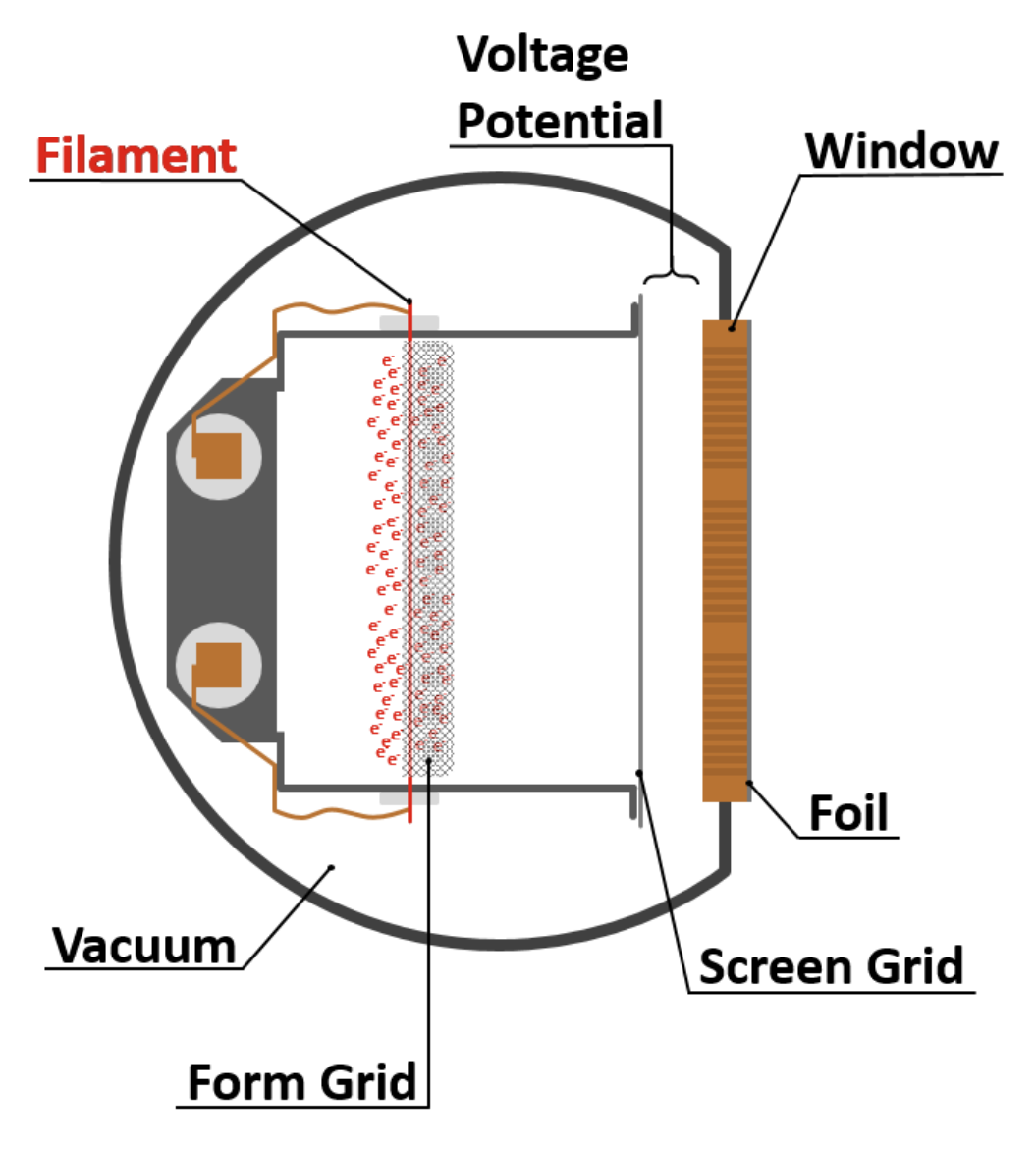
An electron beam uses accelerated electrons to affect material properties. These accelerated electrons are generated by first electrically heating a filament. The heated filament gives off electrons through a process called thermionic emission. The electrons are then accelerated by applying a voltage potential. This process takes place in vacuum; however, once the electrons are accelerated, they escape the vacuum by penetrating through a thin metal foil into atmospheric pressure. Finally, these accelerated electrons are ready to be used in production. As material passes in front of the window/foil, accelerated electrons penetrate into the material and work their science!
What can you do with ebeam?
Oh, the possibilities! Ebeam uses accelerated electrons to break chemical bonds, and thus, initiate chemical reactions. The reactions that take place depend on the type of starting material – typically pre-polymer or polymer – and the chemistry of the material.
With a pre-polymer starting material, such as monomer and/or oligomer, ebeam can cure (polymerize) the material into a polymer. Examples of curing include inks, coatings, overprint varnishes (OPVs), and laminating adhesives. Curing is sometimes referred to as drying because the coatings are applied wet and come out of the ebeam dry; however, this is a misnomer! Unlike thermal dryers that just evaporate water or solvent to dry a coating, ebeam solidifies the coating by bonding molecules together.
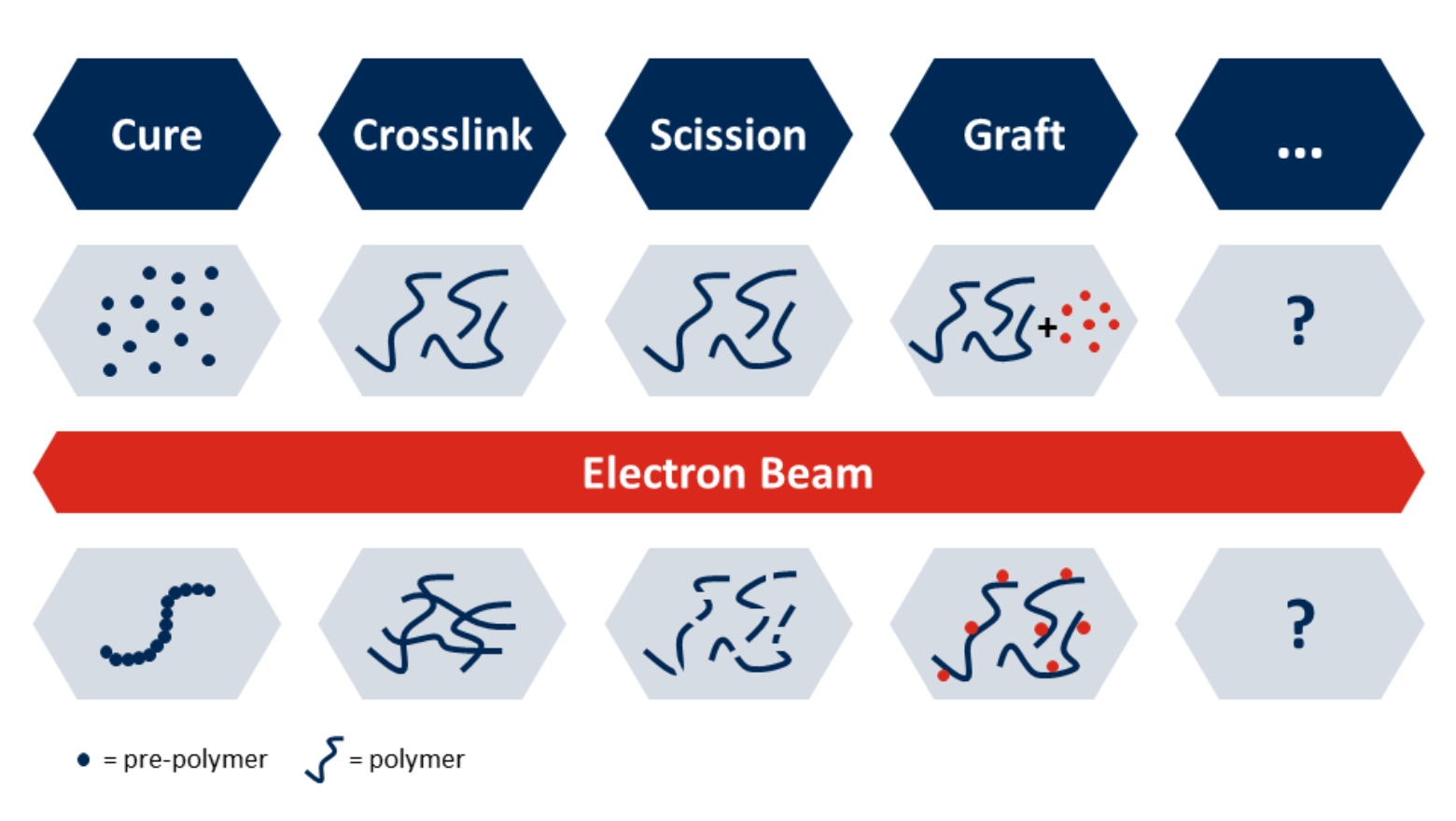
When the starting material is already a polymer, ebeam will break the polymer chains. These broken pieces can bond together in new ways to form a linked network, crosslinking, or the polymer chains can remain broken, a process called chain scission. Crosslinking and chain scission occur in concert; the dominating reaction is dependent on the polymer chemistry. For example, polyethylene is crosslinked by the beam, where as teflon (polytetrafluoroethene) degrades by chain scission. Chain scission is the process by which ebeam sterilizes materials; the DNA (a natural polymer!) of bacteria, pests, etc. is destroyed by the beam.
Grafting requires both polymer and pre-polymer as starting materials. In this process, ebeam bonds the pre-polymer onto the polymer. Grafting is used to modify the surface properties of a film or filter membrane. A common example is grafting a hydrophilic pre-polymer to a hydrophobic filter material to create a hydrophilic filter.
Like many technologies, the future of ebeam is ever evolving. We don’t always know what applications are on the horizon, but here at PCT we are happy to help you with development of new applications. Whether it be modifying inorganic materials, gas to liquid conversion, and/or curing on 3D objects, we can support your vision with our onsite pilot line, applications specialist, and mechanical and electrical engineers. The core principle of electron beam technology is accelerated electrons break chemical bonds. What happens afterward (bonds remain broken, reform, and/or initiate a reaction) is chemistry. How this principle is used to create new ebeam applications is up to your ingenuity!
What are the benefits of ebeam?
Ebeam reactions are instantaneous. That’s instant curing, instant crosslinking, and instant sterilization. You know what they say: time is money! These instant processes also allow for higher throughput with a small footprint. Depending on the application, a single beam can run up to 400 m/min. A single beam can replace multiple banks of UV lights or miles of ovens.
Ebeam technology is energy efficient. It takes less energy to run an ebeam than it does to run your typical industrial UV-curing set-up. Additionally, most ebeam processes take place at room temperature allowing heat-sensitive coatings and substrates to be used.
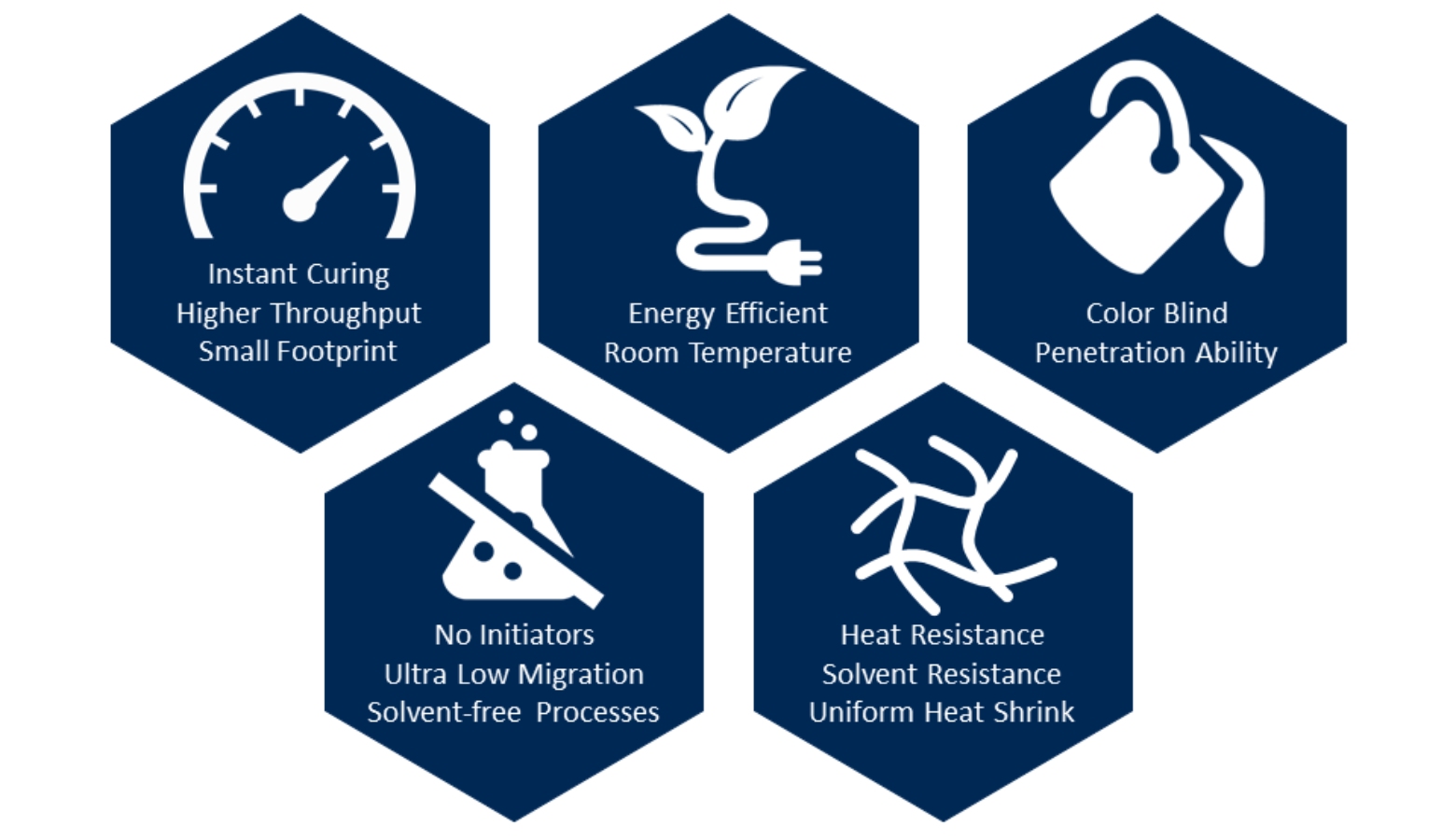
Ebeam is color blind! Unlike UV curing, ebeam’s penetration ability is not dependent on optical clarity but instead material density. This means ebeam can cure richly pigmented inks, from white to black and the rainbow in between, without difficulty. Need to laminate to opaque materials together? Ebeam can do that, too.
Another difference between UV and ebeam curing is the need for an initiator. No initiators are needed to initiate ebeam curing because the accelerated electrons have enough energy to break bonds and start the reaction. UV, however, requires a photoinitiator to initiate the curing reaction. This is an important distinction between the two curing methods, since photoinitiator migration is always a concern in food and pharmaceutical applications. Ebeam is used often in food packaging because there’s no chance of initiator migration (it can’t migrate if it’s not there!) and because the highly formed polymer networks make for ultra-low migration of other molecules without the need for special chemistries. Additionally, ebeam curing is a solvent-free process, which translates to low to no volatile organic compounds (VOCs) and low to no odor instantly after curing. For crosslinking and sterilization applications, solvent-free can be broadened to chemical-free processes. Ebeam does all the work, so no chemicals need be added!
Speaking of crosslinking, did you know that ebeam crosslinking can instantly improve a film’s heat resistance, solvent resistance, and provide uniform heat shrink? Crosslinking polyethylene (PE) is actually one of the oldest applications of low-energy ebeam technology. Furthermore, crosslinking generally adds strength to materials, allowing ebeam users the ability to downgauge their film without downgrading performance.
Got sustainability goals? Ebeam can help!
Sustainability is one of the next big trends in flexible packaging. A number of influential companies are publicly announcing sustainability goals that include improvements on waste reduction, increased use of recyclable packaging, and more environmentally friendly processes. Ebeam can help companies exceed their sustainability goals.
Reduce
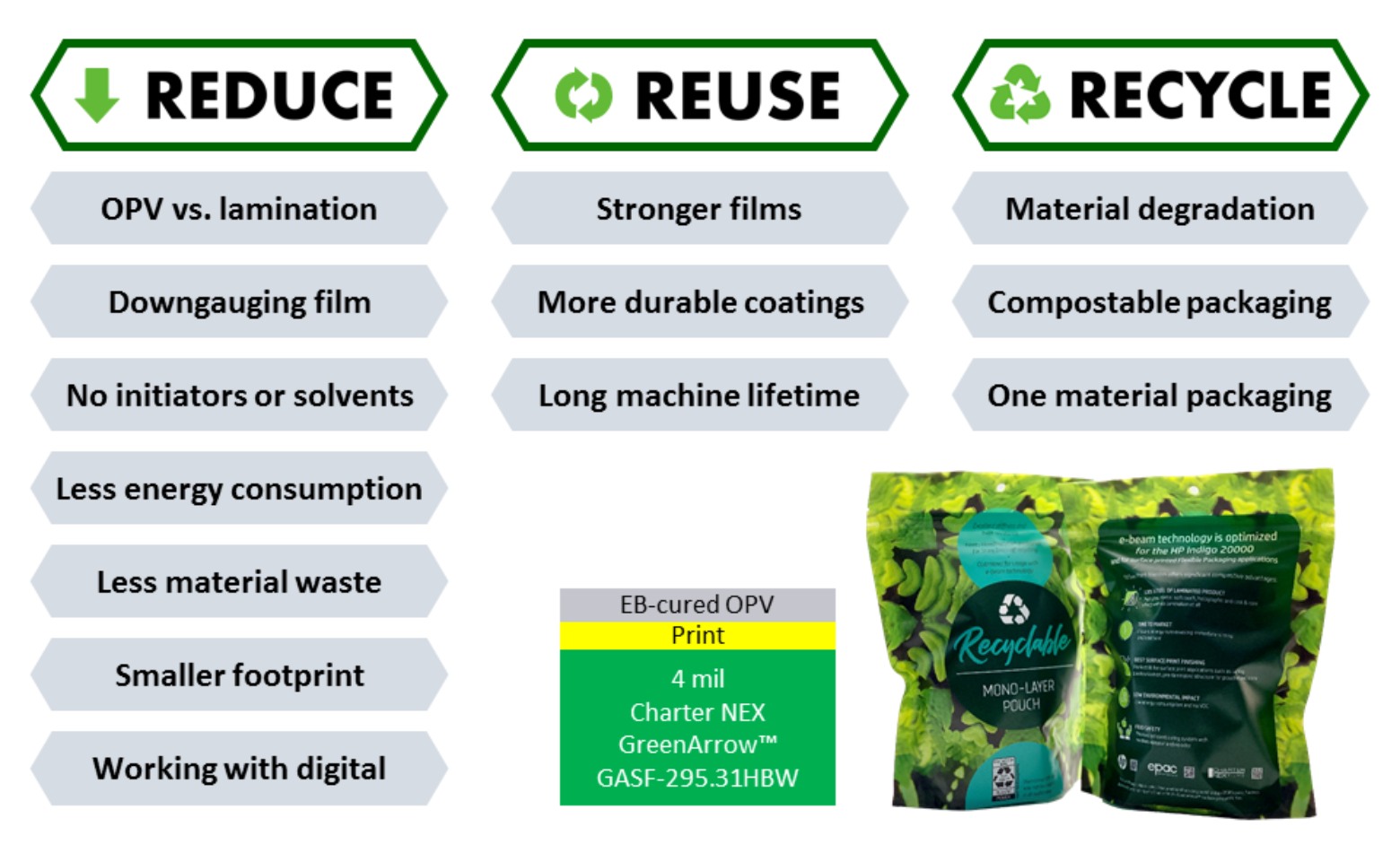
Recall from your elementary school days that the first rule of recycling is not to recycle but to reduce! Ebeam technology takes that rule to heart and allows users to reduce simply through ebeam’s inherent advantages. When touting ebeam’s benefits, we already mentioned downgauging film using ebeam crosslinking, that ebeam has no need for initiators or solvents, and that there’s less energy consumption using ebeam than many alternative solutions. That smaller footprint we mentioned? Think about how that translates to smaller buildings and the reductions that can be experienced there. Overprint varnishes (OPVs), as an alternative finishing option to lamination for packaging, offer packaging protection with less material. Ebeam also has less material waste than other technologies, whether it’s using shelf and line stable OPVs or laminating adhesives or simply eliminating chemistry in crosslinking and sterilization applications. Additionally, while ebeam can be paired with many printing techniques, when ebeam works with digital printing, it benefits from digital’s sustainability: printing only what’s needed when it’s needed and no wasted printing plates when designs are changed.
Reuse
If something cannot be reduced, the next best alternative is to make it reusable. From the perspective of ebeam, increasing reusability means increasing durability. Products made of stronger films and/or more durable coatings have a longer lifetime. Ebeam crosslinking and curing can provide that extended lifetime. Furthermore, the long machine lifetime of an ebeam means it can be reused for years to come. PCT’s pilot line is 35 years old and is still accelerating electrons like it’s 1984!
Recycle
Finally, recycling. Ebeam can aid recycling of some materials, such as paper, through chain scission. The material degradation that ebeam causes makes the material easier to process. Ebeam-curable OPVs are compatible with compostable packaging. Ebeam OPVs also are compatible with recyclable, one material packaging, such as the Charter NEX GreenArrow pouch pictured above. Did you know that much of flexible packaging is made of non-recyclable, multi-layer films that contain several different plastics and sometimes a metallized layer? The combination of multiple materials makes recycling this packaging not feasible. Single material packaging development has increased recently as more and more companies push to make their product packaging recyclable. For both compostable and recyclable packaging, the inks and ebeam OPVs make up such a small percentage of the packaging, the don’t prohibit the composting or recycling of the packaging material.
With ebeam, companies can meet and exceed sustainability goals while improving product performance, efficiency and safety.
New to ebeam? No problem.
Our applications development specialist is here to assist with questions, trial parameters, and/or connecting customers with ebeam-curable OPV and laminating adhesive suppliers. Whether you are adapting a current application or inventing something completely new, we are here to help!
Visit our Ebeam Pilot Line page or Contact Us to learn more.